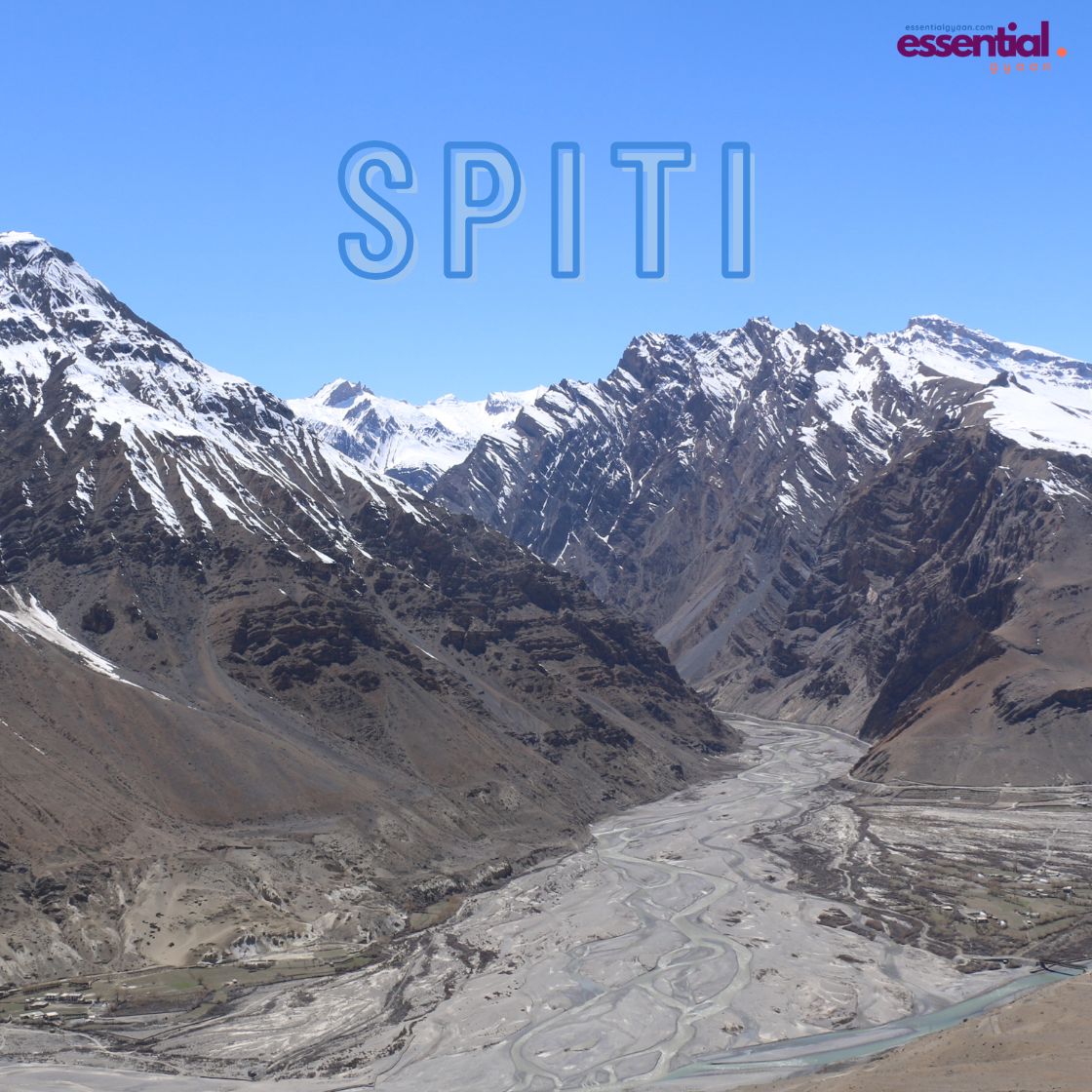
Spiti valley has been in my bucket list since 2018 but it took 6 years of manifestation to finally set foot on this cold desert. Post COVID, when things started coming back to normal and Himachal Pradesh opened its doors to tourists, Spiti became a hot destination for travellers looking to explore the Himalayas beyond Shimla, Manali and Mussoorie.
Fast forward to 2024, I along with 2 of my school friends decided to test the hype created around this Himalayan cold desert and for me it was time to tick off one of the most wished bucket list destination. It was time to fact check those dreamy Spiti valley videos on Instagram which seemed just out of fairytale world. It was time to experience Spiti, travelling 7 days non-stop through rough terrains, high altitudes and hairpin roads.
Where is Spiti Valley Located?
Spiti meaning “middle land” pointing at the region between Tibet and India. Spiti valley is a high-altitude valley located in the north eastern side of Himachal Pradesh, bordering Ladakh in the North, Tibet to the east, Lahaul to the west and Kullu in the South. Marine fossils are found in the upper part of the Spiti valley, which indicates the region was once submerged in the ocean. As per experts, it was submerged in the Tethys Sea some millions of years ago. The Spiti River passes through this valley, forming deep gorges, and eventually meets the mighty Sutlej at Khab.
If you planning to travel to Spiti then based on the season and road status, your trip will either start from Shimla via Kinnaur or from Manali via Kunzum pass. During winter season which mostly lasts till mid may depending on the season’s snowfall, the road from Manali to Spiti via Kunzum pass remains closed. The route from Shimla to Kinnaur valley is open throughout the year subjected to weather conditions and natural calamities.
Our Winter Spiti Itinerary: 8 Days and 7 Nights from Delhi to Delhi
For our Spiti adventure, we chose Go4Explore, a travel company specializing in Himachal tours. Our package included triple-sharing accommodations and comfortable transportation - an AC Volvo bus for the Delhi-Shimla-Delhi legs and 2 Force Traveller vans for the remaining journey within Spiti. The vehicles were impeccably maintained, and our drivers' expertise was evident as they handled the challenging mountain roads with remarkable skill. The group comprised of 18 travellers from various age groups + 2 trip captains.
Day 1: Delhi to Shimla
Started from Kashmere Gate ISBT, Delhi taking a Himachal Pradesh parivahan (HPTDC) AC Volvo bus to Shimla. The bus left Delhi ISBT at 8:30 PM and reached Shimla at 5 AM the following morning.
Day 2: Sarahan | Altitude: 7,589 FT
After getting off at Shimla, everyone got freshened up, loaded our bags into the vans and received a quick briefing about dos and don’ts along with an intro session from the captains. En route, we stopped for a quick breakfast near Windflower Hall Hotel, basking in the blazing sunlight of the mountains while having hot Parathas, Maggi and Chai. The road to Sarahan is covered with Apple orchards, and you can take stops at Fagu & Narkanda for a quick break.
Around 2-3 PM in the afternoon we reached our 1st night halt of the trip, Sarahan and checked-in to our hotel. The stay had all basic facilities with geyser, multiple blankets and kettle for hot water but the best part was panoramic views of Kinnaur Kailash range from the balcony.
Sarahan is a small town located 170 KMs from Shimla (6 Hours). This small town is famous for Bhimkali Mata temple, the presiding the deity of Bushahr princely state and one of the Shakti Peethas. From the top you can get panoramic views of the Kinnaur Kailash mountain range. Former CM of Himachal Pradesh, Virbhadra Singh, is a member of the royal family of Bushahr.
After getting freshened up, we took some pics at the balcony with the majestic Kinnaur Kailash in the background, followed by a visit to Bhimkali temple, located at a walkable distance from our hotel. The temple architecture is a mix of Hindu and Buddhist style construction in the Kath-Kuni style. We reached just in time to witness the evening aarti and seeked blessings for a safe journey ahead. Just outside the temple, you will find small eateries serving Tibetan-style food. We settled at Tenzin Kitchen for snacks but ended up having our dinner as the food here was simple yet super delicious. The town is peaceful, fresh and full of positive vibes, the right setup you need to do a meditation and have a quality ME only time.
In the evening, dinner was arranged by the travel company along with a bon fire setup. Majority of the people took early dinner and retired to bed, preparing their body for the road that lies ahead.
Sarahan Temperature: We visited in first week of May and during the day time you don’t need heavy clothing. However, the nights are chilly and you will need a good headgear and jacket to stay warm.
Day 3: Sangla Valley | Altitude: 11,319 FT (Chitkul), 10,000 FT (Rakcham Village)
Sarahan is also called as the gateway to Kinnaur. After having our breakfast, we started towards Kinnaur valley at 9 AM. First photo stop was Kinnaur gate, a picturesque mountain tunnel gate located near Taranda Dhak Village.
It was my first time in Kinnaur valley and was completely awestruck with the changing landscapes. I couldn’t believe we were driving on the same high cliff roads which you see on Instagram. Hats off to BRO for the construction, maintenance and those cheeky quotes on such dangerous terrain.
Climbing treacherous roads alongside the Baspa River, we made our way to India’s first village in Himachal Pradesh, Chitkul. Located at 11,319 FT above sea level, the place is very windy and super chilly. You may experience altitude sickness in Chitkul; therefore, once you reach here, drink plenty of water, cover your head and most importantly, take it slow. As soon as we got down, we experienced a sudden drop in temperature and a wind blast for around 10 minutes.
Places to See in Chitkul:
- Mesmerizing Sangla Valley
- Peaceful Baspa Riverside
- Hindustan ka Akhri Dhaba signboard
Chitkul is a small town, and you can walk around to explore it on your own. Avoid Hindustan ka akhri dhaba and go for other eateries which serve better food at a reasonable price. Try the eatery just in front of the Akhri Dhaba signboard, which serves Rajma Chawal, Soup, Chai, Maggi & Kadi Chawal. If you are in Chitkul for a day trip, then just go to the Baspa riverside, and from there you can get the panoramic views of the Sangla Valley & Chitkul town. The silence and peace at the riverside amidst the gushing water sound of the Baspa river is a melody to the ears. In case you are having a night halt at Chitkul, take the help of locals and explore short hike options. Homestay and hotel options are available in plenty, but I would advise you to book in advance. The town is located just 10 km from the Indo-China border, and if you check on Google Maps, you will see how close you are to the LAC.
Around 4:30 PM, it was time to go back to our campsite at Rakcham in Sangla Valley. The campsite was nested just besides the flowing Baspa River, making it a bone chilling night halt. Thankfully the campsite had heated beds making it a bearable.
Chitkul Temperature: Even in the month of May, the days were super chilly and windy. As per locals, even when the Sun is out, there is always a cold breeze that leads to sudden temperature drops. The nights are super chilly and can drop to minus temperatures. This is the reason our travel company had planned our stay in Rakcham, Sangla Valley.
Day 4: Khab, Nako & Tabo | Altitude: 12,467 FT (Khab), 12,014 FT (Nako), 10,760 FT (Tabo)
Post breakfast, our journey continued. Today we were going to enter the land of Lamas, Spiti Valley. The first stop on the 4th day of our journey was Khab Sangam, the confluence of the Spiti River and the Sutlej. Spiti River from the valley meets the mighty Sutlej, which originates from Mansarovar Lake in Tibet. The confluence point has an iron bridge and an eatery where you can have your lunch or snacks. You can also spot locals selling Kinnauri apple, a must-try. Trust me, you will stop eating apples in cities if you taste this mouthwatering and juicy Kinnauri apple. Be cautious near the river; the current here is very strong, especially in May when the snow melts in the upper mountains.
Next stop was Nako, a small village in the Kinnaur district with a population of just 600 people. The village is located with a scenic backdrop of Reo Purgyal, highest mountain in Himachal Pradesh with an elevation of 22,362 FT. You can take a walk around the village, interact with the locals and experience the true vibes of a pahadi village. Nako Lake and Nako monastery are the 2 places you can visit, plus if you are visiting around sunset, the perfect point is either to sit by the Nako Lake or watch it from the parking place.
Last stop and today’s night halt was Tabo. Now we have officially entered Spiti valley and were in the Lahaul & Spiti District of Himachal Pradesh. We reached at our homestay in Tabo at 8 PM and after dinner everyone hit their beds, ending today’s 10+ hours of road journey.
Places to See in Tabo:
- Tabo Monastery
- Tabo caves
Places to See in Nako:
- Nako Lake
- Nako Monastery
- Nako Village
Places to See in Khab:
- Spiti & Sutlej Sangam Point
Temperature Today: This was the only day we didn’t need jackets or extra layers. The temperature ranged between 8 - 12 degrees, but with the sun out, we left our warm clothes untouched. Even in Tabo, we didn’t need an extra blanket at night
Day 5: Dhankar Monastery & Kaza | Altitude: 12,774 FT (Dhankar), 11,980 FT (Kaza)
“Difficult journeys lead to beautiful destinations” – Anyone who travels to Spiti will understand the true meaning of this quote. But in this case the journey in itself is amazing you forget all the pain.
Day 5 started early in the morning with an amazing trek and cave experience, thanks to our trip captain Mohit. After all, if you don’t get a bit of dusty in Spiti then your trip was never complete. The trek starts from the road, to stairs and then it’s about going up on the dusty and dry Spiti mountains. Tabo caves or the Monk Caves are located just above the Tabo Monastery and is believed to be carved out 1000 years ago by monks to escape from the freezing Spiti winters. To get there, take help of a local or your trip captain, definitely would not suggest someone with no trekking and mountaineering experience to go up all alone. You can get a panoramic view of the entire Tabo town, the monastery and the scenic Spiti valley with the river. If you are planning to do this, then start early in the morning and be watchful of wild animals who may be inside the cave. After coming down, we visited the Tabo Monastery and then went straight to the hotel to get freshened up, have breakfast and start our journey towards Kaza.
The next stop was Dhankar Monastery, which is located at an elevation of 12,774 FT. The Monastery is located on a height, and you get amazing views of the valley from the top. Especially take the right just before the entrance of the monastery, climb the muddy path, use the stairs and go to the top of the Monastery, now you get to see the amazing Pin valley in one frame, truly the canvas of Mother Nature. The place has a few eateries outside the monastery where we had our lunch and then continued our journey towards Kaza, the sub-divisional headquarters of Spiti. En route, we made a quick stop at Lingti waterfall, which shows its beauty only during the winters when it's frozen; otherwise, it’s just another Drung waterfall. Some of the travellers wanted to take the ice bath challenge and took a dip in the freezing plunge pool created by the waterfall.
Since we had plenty of time, we stopped en route for a photo session near an iron bridge over the Spiti River, flanked by massive, barren mountains on both sides. The backdrop was breathtaking, and the scenic beauty proved irresistible for everyone. Thanks to our adventurous captain, some of the group members took a free ride in the zip trolley that is used by locals to transport cargo above the river.
As we continued our journey to the Kaza homestay, we spotted mountain goats and ibex doing what they do best: clinging to the edges of the steep, rocky slopes. Just a few kilometers ahead, we encountered shooting stones, but our driver—an army veteran—remained unfazed. He explained that whenever mountain goats are spotted, the area is prone to shooting stones due to their movement. Around 5:30 in the evening, we reached our homestay, unpacked everything, got freshened up and then headed to Kaza market for snacks and shopping.
People who love Samosa and Jalebi must visit Sanju Sweets center in Kaza market for hot Samosas and Jalebis. The place is crowded in the evening, and they often sell out by 7:30 – 8 PM. You can get almost everything in the Kaza market, from alcohol to basic needs.
Kaza Temperature: The days are chilly and the mercury drops below zero in the nights. Layering with proper jacket, socks is required and you need to multiple blankets in the night for a comfortable sleep.
Day 6: Langza, Hikkim, Komic, Kibber | Altitude: 14,500 FT (Langza), 15,049 FT (Komic), 14,570 FT (Hikkim), 14,010 FT (Kibber)
Today, we will explore the upper Spiti region, visiting places situated above 14,000 feet. It was going to be a long day, so after an early breakfast, we stopped at the world’s highest retail fuel pump in Kaza, operated by IOCL (altitude: 12,270 feet) for our vehicle’s breakfast.
Since there are no petrol pumps along the entire route today, it’s best to fill up your tank here and carry some emergency fuel as well.
The first stop for today was Langza, yes, the scenic point with a Buddha Statue. Langza is often called the ‘Fossil Village of Spiti’ because of the marine fossils of both animals and plants that were discovered here. Millions of years ago, this region is believed to have been submerged under the Tethys Sea. From the Buddha statue, you get some of the best views of the barren mountains and snow peaks. Also, if you are a professional photographer who is interested in Astro photography, Langza is the best place to view the Milky Way galaxy.
Today, it’s all about visiting the world’s highest. From the world’s highest petrol pump in Kaza, we have now arrived at the world’s highest post office in Hikkim. This village is also one of the highest year-round inhabited locations in India. Previously, there used to be an old post office, but seeing the growth in tourism and people visiting to take photographs at the world's highest tagline board, a new letterbox-shaped office structure has been created. Tourists can buy postcards from shops nearby and send letters to their loved ones from Pin 172114, Hikkim, HP. After getting our postcards stamped, taking some pics with them, we dropped them in the letter box, much to our disappointment at not getting those postcards delivered to our address. Well, the post master definitely has more important things to deliver than do these touristy things! Tip: Locals say due to high demand, not all touristy postcards get delivered, so it’s better to get it stamped at the post office, click photos and take it along with you.
Well, we had come on a Winter Spiti Trip, eager to experience sub-zero cold desert temperature and a totally white washed snow experience. But it was only at Komic, one of the world’s highest motorable villages, that we actually played with snow. Will explain why the white blanket of Snow was missing in Spiti in the last part: Read On! The village is home to just 130 people, a 500-year-old Buddhist monastery, and a café that proudly calls itself the ‘World’s Highest Café.’ By the sixth day of our trip, our bodies had adjusted to the altitude, so we didn’t experience Acute Mountain Sickness (AMS) like we did in Chitkul. Still, the thin air was noticeable, and we saw a few bikers struggling—likely because they hadn’t acclimatized properly before ascending to such heights. Despite the challenges, the place remains beautifully isolated and peaceful, surrounded by snow-capped peaks in every direction. Near the monastery, there are a few eateries if you want to have some quick snacks. Food options at the world’s highest café were limited during our visit, and the price was too high.
Now coming to one of the world’s highest suspended bridges located across a gorge that is 656 FT deep, Instagram’s favourite, Chicham Bridge. This engineering marvel was built in 2017, connecting two high-altitude villages of Chicham and Kibber, cutting travel time from 2 hours to 20 minutes. The bridge is absolutely breathtaking, and if you have a fear of heights, don’t look down the gorge. Chicham and Kibber are among the best places in Spiti to spot Snow Leopards. While we weren’t lucky enough to see one, the owners of a nearby eatery told us that just the day before, a snow leopard had been spotted below the bridge, leisurely enjoying its prized catch.
As we were already late, we decided to just have a drive around the villages of Chicham and Kibber rather than getting down here and exploring on foot. Next stop was one of the postcard-worthy places, which symbolizes Spiti valley, a place that is on every fridge magnet that has Spiti written on it. Yes, the mighty Key Monastery is the largest of its kind in the entire valley. The monastery houses several monks along with young ones who are taught here at the religious training center. After an exhausting day exploring Spiti's high altitudes, we visited the monastery kitchen where we tried the traditional butter tea and local herbal tea, recharging ourselves for the short sunset trek ahead.
Once we were done exploring every accessible corner of the monastery, we set off on a short hike to the sunset viewpoint, the perfect spot to capture a stunning Instagram or Shutterstock-worthy shot of Key Monastery in full glory. To reach this spot, we descended from the monastery’s balcony side and trekked along an unpaved, rocky, and dusty trail. The 15-20 minute hike was challenging, but the breathtaking view from the top made every step worth the effort. Now with this we were done with almost 95% of our amazing Spiti Trip, one more night and then Bye Bye to Spiti.
Temperature Today: Super chilly, windy with sub zero and minus temperatures at some places. Stay layered up, cover your heads and stay hydrated.
Day 7: Gue & Reckong Peo | 10,000 FT (Gue) & 7,513 FT (Reckong Peo)
We were supposed to visit Gue Monastery on Day 4, but due to a shortage of time, it was decided to visit during the return. The roads to this place are in terrible condition, and for the first time, we were dancing to the tunes of the mountain roads. The place is very near the Indo-China Border, and you can see a heavy ITBP presence in the area. The monastery houses the mummified body of Sangha Tenzin, and if you look closely, you can spot hairs, nails and teeth well preserved. The monastery and doors of the house where the mummy is put on display close at 6 PM, so plan accordingly.
After spending sometime at the monastery, we started our ghar wapsi towards Delhi via Reckong Peo and Shimla. Originally our night halt was planned at Kalpa but due to landslides eventually leading to road closure there was a change in the plan and we stayed at Reckong Peo.
Temperature Today: Gue was windy and chilly, but Reckong Peo felt like a city in the plains after returning from Spiti. We slept with fans switched on at Reckong Peo.
Day 8: Shimla To Delhi
Started from Reckong Peo at 10 AM and reached Shimla ISBT at 7:30 PM to catch our HPTDC Volvo to New Delhi.
Spiti Valley Road Condition in May
Roads to Spiti are almost 80% tarred barring few high-altitude places. The roads were very well maintained by BRO and are engineered to perfection.
However, certain routes like the Sangla Valley (Rakcham to Chitkul), Dhankar Monastery (Tabo to Dhankar), Hikkim (Langza to Hikkim), and Gue (Kaza to Gue) were in bad shape during our visit. Also, the road conditions heavily rely on weather conditions, landslides, snowfall, etc. It is always wise to check with locals about road conditions if you are taking your own vehicle. Avoid driving at night, due to extreme temperatures, the chances of encountering black ice increase at night.
Will you get to see Snow in Spiti in May?
In the month of May you are unlikely to experience Snow during your Winter Spiti trip, barring few high altitude places like, Hikkim, Komic, Chitkul, Langza and Chicham. However, check for weather conditions for Snowfall chances and plan accordingly. During snowfall there are high chances of roads getting closed leading to extension of your trip. So, if you visiting as per weather predictions, keep contingency days in hand.
If no Snow, then why Winter Spiti?
Travel companies have divided Spiti season into two halves, Winter: when the Kunzum pass and Chandra Taal are not accessible and Summer: when trip stats from Shimla and ends in Manali via Kunzum pass and Chandra Taal. For a total white washed Spiti experience, visit from Jan to March but be prepared to face the extremes.
Now Final Verdict: Is Spiti with Barren Mountains worth the Hype and Struggle
Spiti: Nature’s own Canvas. Only when you visit and experience it on your own then you will get to know its beauty. Due to extreme climate, altitude and absence of alternate modes of transport, this side of Himachal is not yet exposed to the adverse effects over tourism. But Spiti is 101% worth the hype and pain.